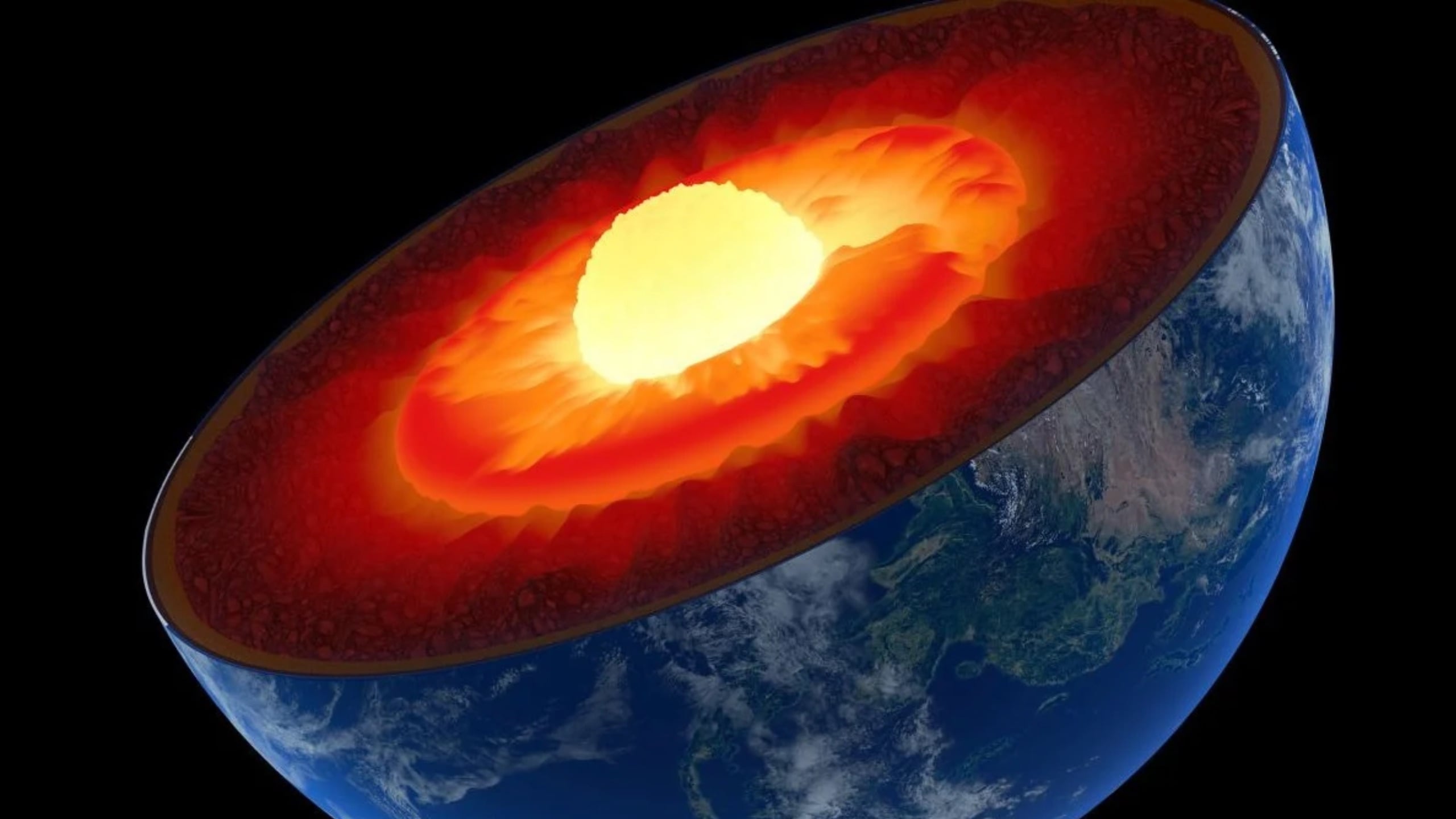
A question as old as the planet
A team of geoscientists from the University of Science and Technology of China, in Hefei, set out to address a long-running puzzle about Earth's interior, ScienceAlert reported. The deep mantle shows chemical differences from place to place. Are they leftovers from the planet's crystallization out of a magma ball? Or do they show that the core and mantle have been swapping chemicals since very early in Earth's history?
The question reaches back to the planet's violent beginnings. Early Earth was a molten body covered by a global lava ocean and bombarded by space rocks, according to the report. Over roughly 4.5 billion years it settled enough for complex life to emerge. The core, however, is still molten and described as blazing about as hot as the surface of the Sun.
How the researchers tested it
The study, published in Science Advances, used machine-learning-boosted "path-integral simulations" to explore the quantum behavior of atoms and molecules. This approach let the team analyze how hydrogen moves through Earth's interior. Hydrogen is especially quantum-quirky because it is so light, ScienceAlert noted.
The researchers focused on the ratio of deuterium, a heavier hydrogen isotope, to ordinary hydrogen, known as the D/H ratio. They wanted to know whether lighter hydrogen was rising from the deep Earth, for example through plumes that feed volcanic eruptions at the surface.
Their crystallization model found that the sorting of isotopes between minerals and melt is fairly weak. That would give the ancient mantle an even D/H distribution. In the researchers' words, the results indicate that magma ocean crystallization "yields a primitive mantle with an essentially homogeneous hydrogen isotope composition, despite large variations in pressure, temperature, and model assumptions."
What the volcanic rocks suggest
The team found the most important factor was the magma ocean's starting hydrogen isotope composition. Other variables, including initial water content estimated at up to two ocean masses, had little influence. ScienceAlert described the early conditions as too energetic for deuterium and hydrogen to be neatly sorted through Earth's layers.
Evidence for leakage from the core comes from ocean island basalts, which form from upwellings near the boundary between the core and the mantle. The report names lavas erupting in places such as Baffin Island and Iceland. These rocks appear to carry light hydrogen gathered from the solar nebula, the cloud that formed the Solar System. As that hydrogen escapes upward, it enriches the mantle and lowers its D/H ratio.
Helium offers a second clue. Helium-3 is a lighter, primordial isotope from the solar nebula, while helium-4 is produced by radioactive decay in Earth's upper layers. A higher helium-3 to helium-4 ratio in these basalts is further evidence of escape from the core, according to the report.
Tungsten is the third piece. This heavy metal was initially sequestered in the core as Earth separated into layers. An isotope of tungsten now rides rising plumes, tracing core material as it moves upward. Together, the hydrogen, helium and tungsten ratios are presented as markers of a leaking core.
What the authors conclude
The researchers say their findings bear on how deep-mantle chemistry should be interpreted. "These findings suggest that even if primordial deep-mantle reservoirs once existed, the hydrogen isotope signatures in the present-day deep lower mantle are unlikely to represent simple relics of early differentiation," they wrote.
Instead, they said, those signatures "reflect dynamic modification by ongoing core-mantle exchange throughout Earth's evolution." The source material does not describe follow-up studies or independent verification of the findings.