NBC Selected independently determines what we cover and recommend. When you click on or buy through our links, we earn a commission. Learn more .
I hate to break it to you, but the tap water you’re soaking in when you take a bath is likely not filtered whatsoever. It’s totally safe, but it may have impurities in it that can irritate skin (especially for babies and kids ) and dry out hair , like chlorine, chloramine and hard water minerals. That’s where a bath filter comes in.
Like filtered showerheads , bath filters remove impurities as water comes out of the spout, so by the time it makes its way into your tub, it’s more purified. I’ve been testing bath filters for over a month, have done extensive research about them and talked to experts about how (and if) they really work. Find out everything you need to know — including which models I recommend — below.
Best for families Canopy Bath Tub Filter $undefined $89.00 Amazon Learn more Best to use as needed Tru Bath Water Filter $27.99 $29.99 TRU Water Filters Learn more Want more from NBC Selected? Sign up for our newsletter, The Selection, and shop smarter. Bath filters are exactly what they sound like: filters for bath water.
They’re point of use filters, which means they treat water directly at the fixture, says Deon Marecheau, a Thumbtack pro and the owner of Antillean Restoration . As water comes out of the tub spout, it passes through the materials inside the filter (a.k.a. filter media), which traps impurities like sediments, minerals, chlorine and odors.
Then, by the time the water gets to you, it’s in its most purified state. In my experience, bath filters are much easier to install compared to shower filters — there’s absolutely no plumbing or home improvement experience necessary. In fact, you don’t even need to replace your tub spout to use bath filters.
You simply slide them over or hang them from your spout so they’re positioned right underneath water as it comes out. I tested all of the bath filters I recommend below to share my first-hand experiences with them. They’re designed to fit most standard bath spouts across shapes and sizes, according to the brands.
Water comes out of my spout at about the same rate with each of these filters attached as without — I haven’t noticed that it’s taken longer to fill up my tub since I’ve installed either of them. The bath filters included on my list come with one pre-installed filter (you have to buy replacements after a certain period of time) and all of the parts required for installation. To back performance claims, each brand either provides third-party testing data online or sent it to me via email when I requested it.
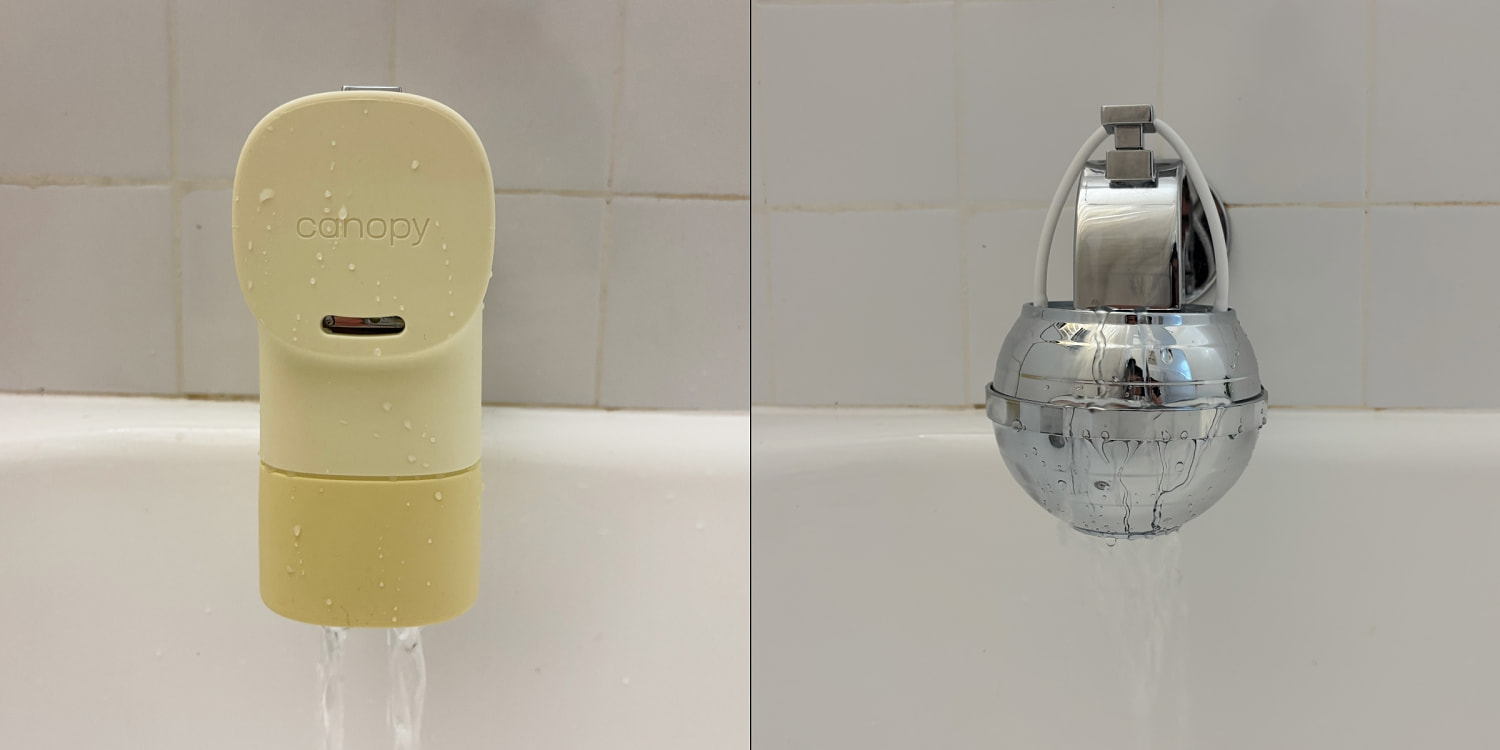
I’m testing bath filters on an ongoing basis, so I’ll continue updating this list with more options. I hadn’t heard of or tried bath filters prior to Canopy’s, and when mine arrived, I was pleasantly surprised by how easy it was to install. Unlike filtered showerheads, I didn’t need to take off my tub spout to install it — I just slipped an attachment band (which looks like a thick, wide rubber band) over my spout, slid the filter over it and made sure the opening was directly underneath the area where water comes out.
The installation process took less than a minute and the included directions were very clear. Anyone can use Canopy’s bath filter, but it’s designed with features that tailor it to kids’ needs. For example, the filter is made from a soft silicone material and it completely covers the spout, protecting kids from bumping their head on the hard metal.
It also has a built-in temperature indicator on the side that turns red when water is too hot, signaling that it might be uncomfortable for kids’ skin. I babysit for a handful of families who own Canopy’s bath filter because they have young children, but as an adult who uses it in my home, it doesn’t feel like it’s “for kids” — it has an universal appeal, in my opinion. Canopy’s Bath Filter slides onto my spout in seconds, so I could take it off and only install it as needed.
I find it easier to leave on, though, and that seems to be what it’s designed for. The filter is easy to replace, too. There are finger tabs on each cartridge, which I pull down on to pop it out before adding a new one.
Without the filter inside, the entire silicone fixture is top-rack dishwasher-safe so you can give it a deep clean. Tru’s Bath Water Filter is somehow even more straightforward to install than Canopy’s. It comes with a hard plastic hook you attach to the spherical filter, letting you hang it on your tub spout, positioning it over the part where water comes out.
The pull on your spout keeps the filter in place. If your spout doesn’t have a pull, the filter comes with a long flexible hook you attach to the filter instead of the hard one, and you wrap around the spout once to keep it in place. You also get a little funnel attachment you can add to the filter if your spout’s water flow is too large.
The funnel helps direct the water into the filter. That’s all there is to this filter. It doesn’t have any bells and whistles, and I appreciate the simplicity.
I also like that Tru’s Bath Water Filter doesn’t cover my tub spout at all — I find that it’s best used as needed because of this. I hook it onto my spout when I’m filling up my tub and take it off when I’m just showering so I don’t have to keep it out all the time. To replace the filter, I screw open the fixture, take out the old filter, add a new one and screw it back together.
To test bath filters, brands sent me models as courtesy samples. I installed them in my apartment’s bathroom and I used each filter for at least two weeks. After attaching a filter to my spout, I completely filled up my tub multiple times with warm water.
I noted how easy the filters were to install, how they worked and whether I noticed any differences in how the filtered water impacted my hair and skin. I went through the process of taking filters out of each fixture and replacing them, too. I’ve tested bath filters for over a month so far, and I’m continuing to use them to evaluate my results.
Right now, I haven’t experienced any noticeable changes to my hair or skin, but I don’t take baths daily. I use my filtered showerhead daily, however, and after installing it, I very quickly noticed that my skin and hair felt softer and less dry — if I used my bath filter daily, I have a feeling I’d have the same experience. Noticing results with bath filters isn’t incredibly important to me though.
I simply like knowing that when I take a bath, the water I’m soaking in is more purified than it would be if I didn’t use a bath filter. That’s enough to make buying and using one worth it to me. Experts recommend considering the following factors while shopping for bath filters, all of which I considered while testing them.
Filter media : Filter media refers to the materials inside a filter that removes and holds onto contaminants as water passes through. The specific type of media dictates exactly what gets removed, and brands often make mixed-media filters to address various impurities. Some of the most common media inside bath filters are activated carbon, calcium sulfite, ceramic and copper-zinc, which reduce the presence of chlorine, chloramine, hard water minerals and odors in water that can impact your skin, hair and plumbing, experts told me.
I only recommended mixed-media bath filters from brands that disclose exactly what’s inside. Certified claims : There aren’t any federal regulations around residential water filters, including bath filters. To verify that the one you buy actually works as the brand describes, Marecheau says it’s crucial to review third-party testing data that supports performance claims, which you may find on the brand’s website.
If not, you can request a copy via email. Some brands, for example, test their filters against voluntary standards set by organizations like public health nonprofits — the National Sanitation Foundation (NSF) is...