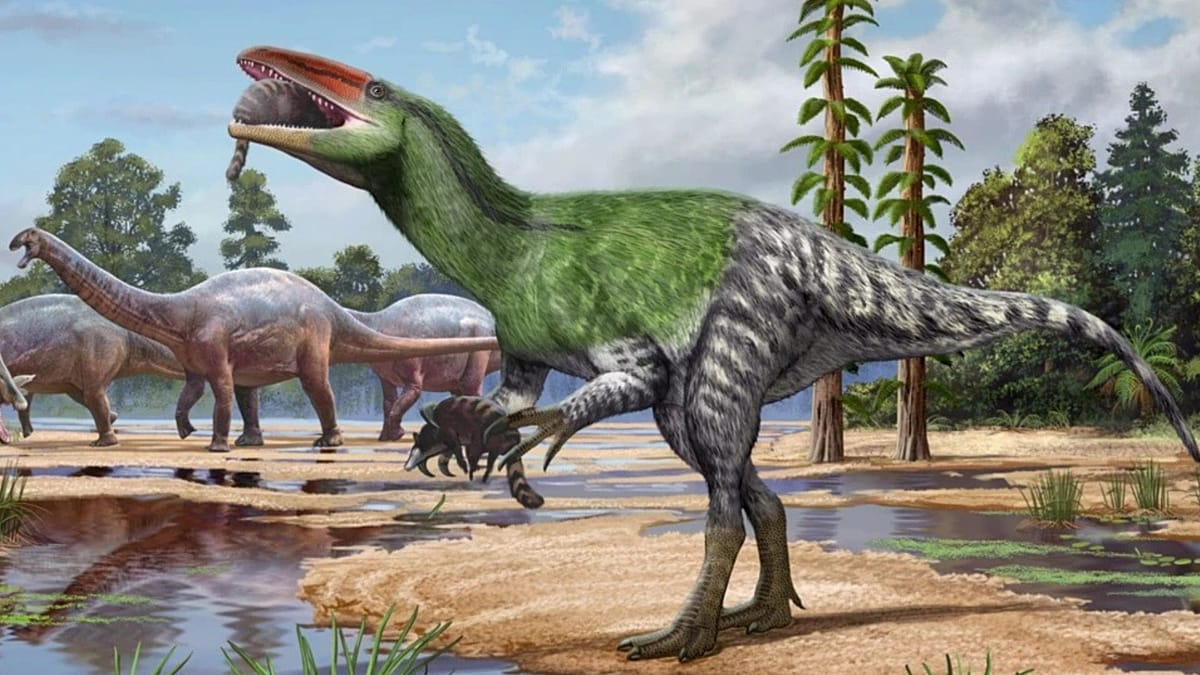
A century-old fossil gets a new identity
A dinosaur fossil that sat in the collections of London's Natural History Museum for almost a century has been identified as a previously unknown species, according to Euronews. The skull fragment belonged to Invictibellatrix amberina, a carnivorous dinosaur that lived around 120 million years ago.
The find is also the first confirmed evidence of a megaraptoran dinosaur in Europe. Members of this group had previously been identified in Asia, Australia and South America, but never conclusively on the European continent.
The findings were published in the journal Royal Society Open Science.
How the fossil reached the museum
The fragment was originally found at the foot of a cliff on the southwest coast of the Isle of Wight by an amateur fossil hunter, Reginald Walter Tooley. After his death in 1924, the Natural History Museum acquired more than 1,000 specimens from his collection, including this one.
Scientists knew the fragment came from a dinosaur, but exactly which one remained unresolved for decades. Researchers recently took a fresh look using CT scanning technology, which allowed them to examine its internal structure and create a 3D model.
What kind of dinosaur it was
Despite the name, megaraptorans were not the small, bird-like dinosaurs usually associated with the word "raptor." According to the Natural History Museum, they were larger predators more closely related to tyrannosaurs, with "slender heads," "large arms" and "giant curved claws."
Invictibellatrix amberina is estimated to have measured between 3 and 4 metres (10 and 13 feet) in length and to have stood around 1.5 metres (5 feet) tall. It lived in the Early Cretaceous period, when dinosaurs dominated land ecosystems. Researchers have suggested it may have had feathers, though its exact appearance remains uncertain.
Dr Cassius Morrison, a researcher in University College London's Earth Sciences department, said the species would have eaten small dinosaurs, lizards and mammals, occupying a place in the food chain similar to that of a hyena today.
What the researchers say
Morrison, who led the study, said the animal "was not the apex predator of its time, but for humans this dinosaur would have been more dangerous than a T. rex." He added that humans would have been "perfectly sized prey, about a third of their body weight," and that "they definitely would have chased us." A T. rex, he said, would not have bothered because people would have been too small.
Professor Paul Barrett, the study's senior author from the Natural History Museum, said that "despite over 200 years of collecting, the Isle of Wight continues to surprise us with new dinosaur species, and finds of carnivorous dinosaurs, such as Invictibellatrix, have been particularly elusive."
Barrett also said the work "shows the exceptional value of working with historical museum collections where there are still many discoveries to be made."