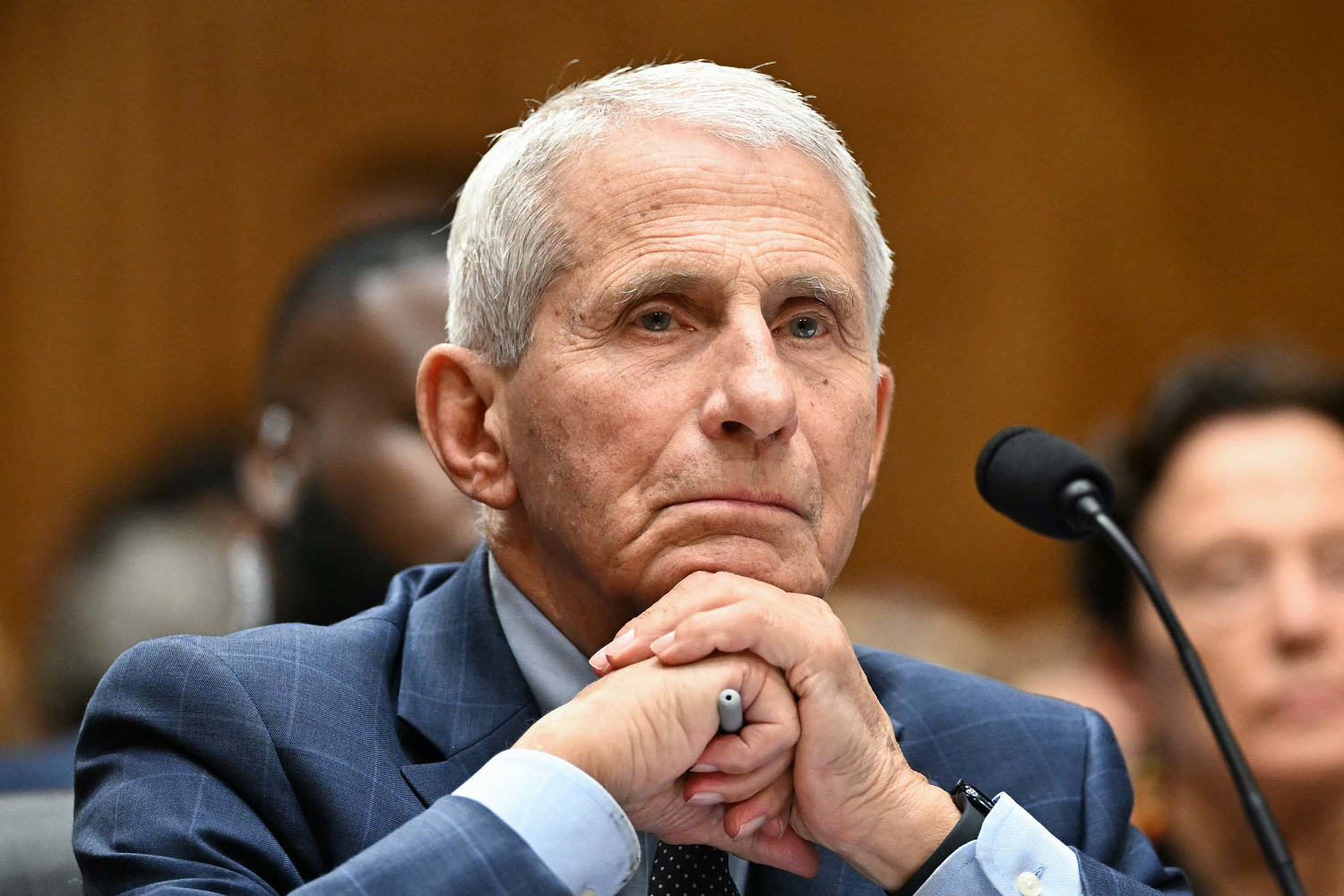
Dr. Anthony Fauci declined to answer senators’ questions at a contentious hearing Wednesday on the origins of Covid and the government’s handling of the pandemic, saying he would invoke his Fifth Amendment right to avoid the possibility that Republicans use his testimony to prosecute him for perjury. The surprise decision set the stage for a hyper-partisan hearing that yielded no new revelations about the origins of the coronavirus or the government response to the pandemic.
But the absence of Fauci’s testimony presented plenty of opportunities for Republicans and Democrats to present dueling narratives about those issues — and about the doctor himself. Republicans on the Senate Homeland Security and Governmental Affairs Committee used their allotted time to criticize the doctor’s recommendations during the Covid pandemic as the former head of the National Institute of Allergy and Infectious Diseases, accusing him of providing harmful advice on issues such as lockdowns and of lacking candor on the origins of the coronavirus. Democrats, meanwhile, came to Fauci’s defense, painting the hearing as a Republican-led effort to entrap Fauci into committing perjury and using their time to focus criticism on the Trump administration’s health care policies.
After Fauci had invoked the Fifth Amendment more than 100 times, committee Chairman Rand Paul, R-Ky., said as the hearing ended that he would call for a vote to hold Fauci in contempt of Congress. He said after the hearing that the committee would vote on the issue next week. Paul, a longtime critic of Fauci, has clashed with the doctor numerous times at past congressional hearings.
Paul has accused him of lying to Congress on the issue of “gain of function” lab research on viruses, which makes them more dangerous in order to better understand them, and whether funding from the National Institutes of Health ultimately made its way the Wuhan Institute of Virology. Fauci has previously denied the allegations. On Tuesday, Paul responded to a reporter’s question about how he would respond to people who argue that the senator was trying to put Fauci in a position to perjure himself.
“There’s no risk to perjury if you tell the truth,” Paul said. “In fact, he can even admit to not telling the truth in the past. He can admit destroying records.
He can admit to, you know, not adequately presenting both sides of equations, which isn’t really a crime. He can admit to anything. The only thing he can’t do is lie again.” In his opening statement, Fauci said Paul’s repeated attacks on him formed his rationale for deciding to invoke his 5th Amendment right.
The doctor cited what he characterized as the senator’s “obvious obsession with calling for my prosecution, his repeated slanderous comments about me” and his decision to publicly release the doctor’s personal journal. “The only conclusion I can reach is that the sole reason he is calling me before this committee is to get me to say something — anything — that could vindicate his repeated public pledges that I end up, in his words — quote — ‘behind bars,’” Fauci said in his opening remarks. “Any reasonable person who has followed his unhinged obsession with me would readily come to the same conclusion,” he continued.
“Therefore, although it pains me to do so because of the respect I have for the legislative branch of government and my decades-long record of cooperating with Congress, under the advice of my attorneys, I will invoke my right under the 5th Amendment of the Constitution to refrain from answering your questions.” In the final hours of his administration, former President Joe Biden issued a pre-emptive pardon to Fauci and others to shield them from what Biden characterized as potential political prosecutions. This week, Paul did not preclude that Fauci could face charges over his testimony, saying “we’re going to find out” if he should be prosecuted. That pardon was a factor in the decision-making from Fauci’s legal team in determining that the former infectious disease expert should not answer senators’ questions because Republicans had consistently implied that pardon would not apply to new statements.
During the hearing, Republican senators repeatedly tried to goad Fauci into responding to their questions — with Sen. Josh Hawley, R-Mo., at one point asking the doctor to identify the colors of his tie and the floor’s carpeting. Fauci answered each question, regardless of the topic , with the same line: “On the advice of counsel, I respectfully decline to answer based upon my rights under the Fifth Amendment to the Constitution.” At the end of his period of questioning, Paul told Fauci that he would face “repercussions” for not answering.
“The committee will have to consider after this hearing what appropriate action should be taken against you for the failure to testify after being directed to do so,” Paul said. “It’s against the law to obstruct an investigation of Congress. There will be repercussions to your refusal to testify today.” When Paul concluded, Fauci’s lawyer, David Schertler, tried to say something to the senators but was repeatedly cut off by Paul, who ultimately ordered security to remove Schertler from the committee room.
Shortly after he left the hearing, Schertler told NBC News that Fauci “has a valid Fifth Amendment privilege, and he has the right to assert it.” “That’s what I was trying to tell the committee, and that’s all I was trying to tell the committee,” he said. In a separate statement, Schertler called Paul’s actions “outrageous.” “It proves the baseless and vindictive nature of this proceeding and Rand Paul’s personal vendetta against Dr. Fauci,” he said.
During his time to speak, the top Democrat on the committee, Sen. Gary Peters, D-Mich., criticized the Republicans’ handling of the hearing, saying he believed the hearing “does real damage.” “It’s tempting to turn one person into the scapegoat for a crisis that hundreds of officials across both the Trump and the Biden administration were responsible for handling,” Peters said, adding that people were facing death threats. “This is only going to, unfortunately, deter other scientific experts from public service to understand that this is what they would have to go through as they provide their advice to us,” he added.
Separately, Sen. Richard Blumenthal, D-Conn., told reporters ahead of his period of questioning that he would not ask Fauci questions, arguing that the “show trial is a perjury craft for criminal prosecution going forward.” During the hearing, Blumenthal defended Fauci and and compared the Republican-led proceedings to the McCarthy hearings of the 1950s. “We should not be part of a rerun of that kind of effort,” Blumenthal said.
“This attempt to rebrand one of the most challenging times in our nation’s history is a short-sighted act of desperation that will leave us less prepared for the next pandemic.” Schertler said in a statement that the circumstances surrounding Fauci’s appearance “regrettably made his continued cooperation impossible,” accusing Paul of taking “an intense and seemingly pathological course of retribution, revenge, and obsession with Dr. Fauci” that has ultimately led to the doctor and his family facing threats and harassment. “Dr.
Fauci devoted his lengthy career to saving millions of lives globally through scientific discovery and sound public health policy,” Schertler said in the statement. “The accusations that Chairman Paul continues to propagate are false and disgraceful, and we will examine all options to hold him accountable.” Monica Alba is a White House correspondent for NBC News. Megan Brand is a politics reporter for NBC News.