What the administration is asking
The Trump administration on Wednesday asked the Supreme Court to let it resume, for now, construction of a border wall and other infrastructure through a remote part of West Texas that includes Big Bend National Park, according to CBS News. The Justice Department wants the justices to lift a lower court injunction that temporarily bars the Department of Homeland Security from building barriers or related infrastructure in the Big Bend Sector.
The sector covers more than 500 miles of the U.S.-Mexico border and 77 counties in Texas. In the emergency request, Solicitor General D. John Sauer wrote that the injunction "significantly frustrates the government's ability to stop the flow of illegal aliens and drugs across the southern border." He added that the secretary chose the project areas because of high rates of illegal crossings and drug smuggling in the region over the past several years.
The project and the waivers
The administration announced in February that Homeland Security would build barriers and roads in the Big Bend Sector. The plan includes 30-foot-tall bollard walls running from Fort Quitman, Texas, to Closed Canyon in Big Bend Ranch State Park. According to the government, border walls and roads would span more than 300 miles.
Customs and Border Protection has said the wall itself will not cut through Big Bend National Park, but other infrastructure would, including patrol roads, detection technology and roughly 17 miles of vehicle barriers. CBP said construction of a 47-mile stretch of wall in the region began last month, and the Justice Department said contracts have been awarded for five border-barrier projects in the area.
A project with this kind of effect on cultural, recreational, wildlife and environmental resources would typically require compliance with federal environmental protection and historic preservation laws. But then-Secretary Kristi Noem invoked a 1996 immigration law that lets the secretary waive legal requirements deemed necessary for quick construction of barriers and roads near the border. Her successor, Markwayne Mullin, issued two more waivers.
The court fight
An environmental nonprofit, a professional riverboat guide and a religious organization filed suit in April to stop the project. The administration argued the land is an area of "high illegal entry," saying more than 89,000 people were apprehended trying to cross illegally in the sector between 2021 and 2025.
The plaintiffs countered that the Big Bend Sector ranks last in apprehensions among the seven southern border sectors. According to court filings cited by CBS News, although the area covers more than 25% of the border, its annual apprehensions ranged between 0.3% and 2.2% of the border-wide total.
Earlier this month, U.S. District Judge Kathleen Cardone granted a preliminary injunction barring DHS from building barriers or related infrastructure, or conducting "any construction or ground disturbing activities" in the sector. She found that Noem and Mullin exceeded their authority in issuing the waivers between February and July. Just before the Justice Department went to the Supreme Court, Cardone declined the administration's request to pause her ruling.
Reaction and earlier backlash
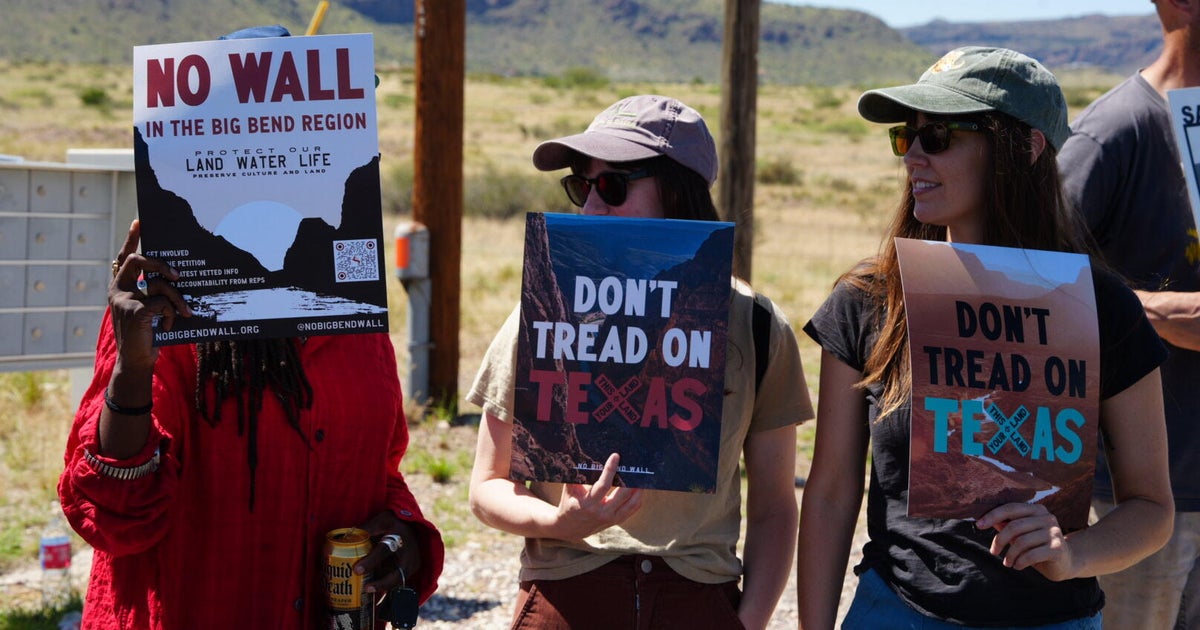
The Center for Biological Diversity, which is challenging the effort, pledged to keep fighting. Senior attorney Zeynep Graves said in a statement that the group is "deeply disappointed" the administration is seeking a green light "to bulldoze one of America's wildest, most extraordinary landscapes." She said the group is confident "only Congress can authorize something as consequential as walling off the entire U.S.-Mexico border."
The project has already drawn resistance. CBS News reported that earlier this year lawmakers in both parties, cattle ranchers and local law enforcement officials in Texas pushed back after social media photos and videos showed bulldozers arriving at the park. In response, CBP Commissioner Rodney Scott paused construction inside the park until the end of September.