What the records show
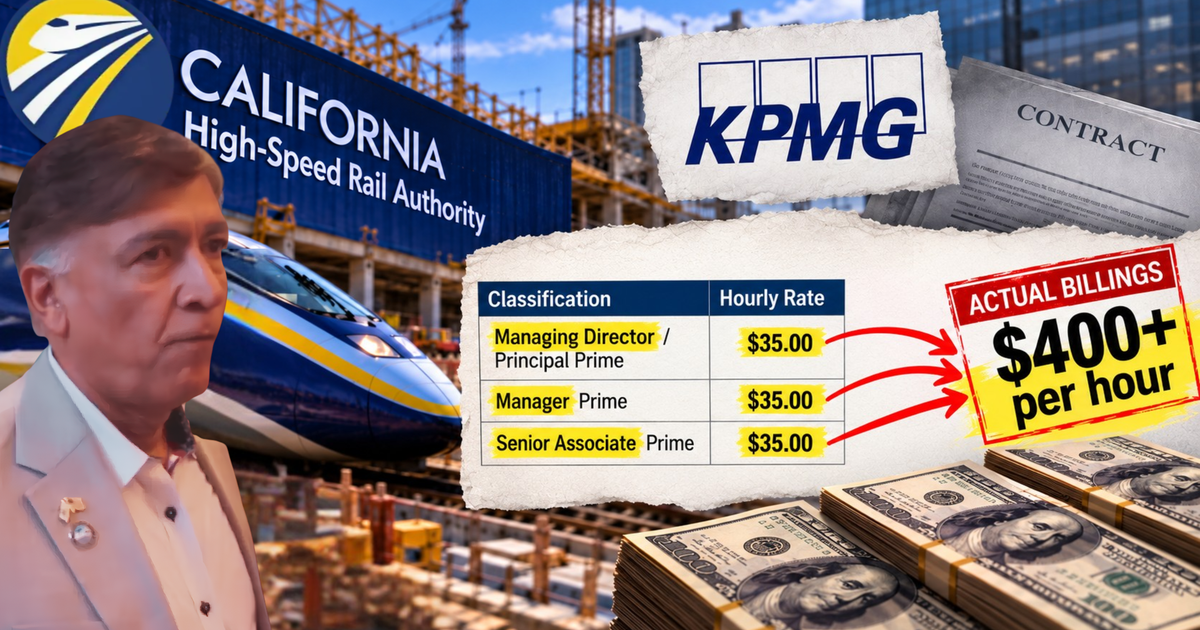
According to records obtained by CBS California, the California High-Speed Rail Authority awarded a $24 million, four-year contract to KPMG while aware that the firm intended to charge more than its unusually low bid for senior positions. KPMG's winning proposal listed an average hourly rate of roughly $200. CBS California reported that the average rate actually billed was more than double that.
The outlet said KPMG billed about $2 million more in four months than its winning cost proposal indicated. In its first year, the firm has spent nearly half of the contract's value.
The bid cut hourly rates for "Managing Directors," "Managers" and "Senior Associates" from hundreds of dollars under a prior contract to $35. KPMG then raised the rate for its lowest-experience "Associate" position from $45 to $425. CBS California reported that when the authority assigned work to the $35 managers and senior associates, KPMG billed those people as Associates at $425. The outlet said it could not find a single KPMG staff hour billed at $35 on the invoices it reviewed.
The losing bidder's protest
CohnReznick Advisory, the runner-up, scored higher than KPMG on technical qualifications but lost by two points on price. It filed a protest with the state accusing the authority of allowing KPMG to manipulate its bid. The company argued that KPMG never intended to charge $35 an hour and was offering artificially low rates for positions it did not plan to staff.
CBS California reported that the signed contract lists a manager rate more than ten times higher than the one in the winning proposal. Under the legally mandated scoring rules, the outlet said, the runner-up would have won had KPMG bid the higher contract rate. The protest also noted that KPMG Managing Director Thierry Prate was listed as a partner at $460 an hour rather than at the $35 managing director rate.
The authority defended the bid, arguing the allegations were speculative and that nothing showed KPMG would not honor it. It said KPMG's staffing and job classifications met the bidding requirements.
Oversight questions and responses
State officials dismissed the protest as "mere speculation," according to the records, but explicitly warned the authority not to pay higher rates for work assigned to the $35 positions. CBS California reported that the authority did exactly that. It also said evaluators flagged budget concerns while scoring the bid, noting that KPMG's proposal assigned no staff to the $35 positions. The contract was awarded anyway.
KPMG did not deny the findings. A spokesperson said the firm's December 2024 bid "detailed the people who would work on the engagement, their job classifications aligned to the state's definitions, and the associated billing rate for each person."
After the story was first published, the board chair told CBS California she would formally ask the Office of Inspector General to begin an independent review of the contract, the billing practices and the authority's oversight procedures. "Our responsibility is to the people of California," she said in the statement.
CEO Ian Choudri and Prate, who signed the contract, did not respond to emails, CBS California said. The outlet reported that Choudri declined to answer questions in person after a recent board meeting and that the authority has not answered its requests for comment or a public records request filed more than a month ago.
Wider concerns around the project
CBS California also reported that KPMG billed hundreds of dollars an hour for subcontractors, including a former High-Speed Rail CEO and a former board chair. It said legal consultant Brent Butzin began billing at $589 an hour after using much of his initial budget, a rate above the highest allowed under the contract.
Prate and Butzin, both from Denver, were flagged in an Inspector General investigation into unallowable travel spending. The authority told its board it paid four consulting firms nearly a quarter-billion dollars over two years, and said the questionable travel amounted to less than 1% of that. CBS California reported that Choudri's fiancée now works for KPMG, which holds more than a half-dozen active California contracts worth over $200 million. The outlet has not reviewed those contracts.
The reporting comes as the project is projected to run out of money in 2027, according to CBS California, which also said the authority lost $4 billion in federal funding after missing deadlines to buy trains. The authority's public relations team disputed a characterization that the project has fallen further behind under Choudri, saying it has advanced significantly. CBS California declined to correct its story, citing the 2026 Business Plan, which it said shows a timeline extension of at least nine months.