What is on the ballot
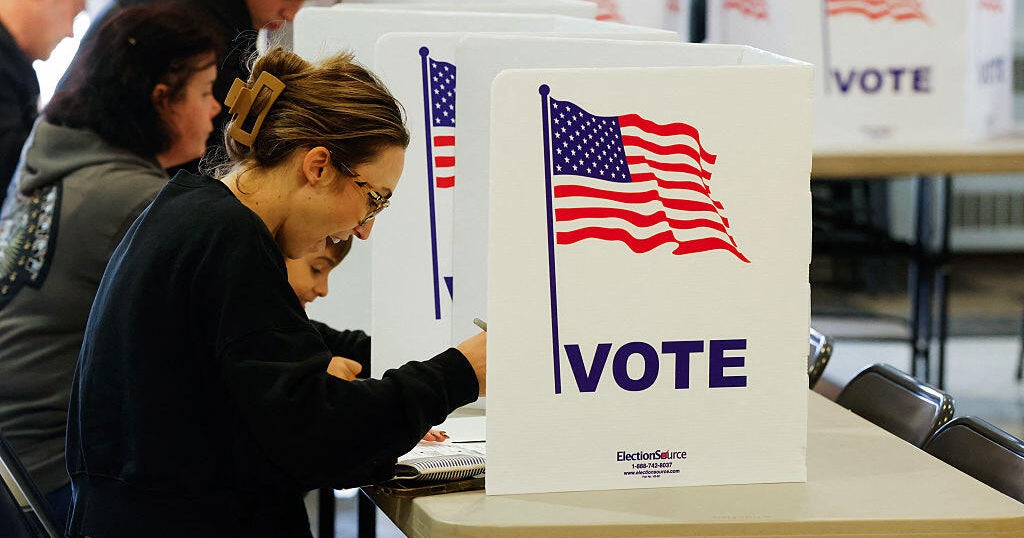
Control of Congress and the future of President Trump's legislative agenda were in voters' hands Tuesday as Americans went to the polls in the 2026 midterm elections, CBS News reported. All 435 House seats and 35 Senate seats are being contested, and 36 states are choosing governors.
Attention is focused on 11 battleground Senate races and dozens of competitive House districts. According to the University of Florida Voting Lab, more than 59 million Americans had already voted early.
The first polls are set to close at 7 p.m. ET in Georgia, Indiana, Kentucky, South Carolina, Vermont and Virginia.
Machine problems in New York and Georgia
Westchester County, New York, part of the battleground 17th District, reported that ballot scanners were down when polls opened. State and local officials said every vote would be counted, and candidates urged voters not to leave their polling places if lines were long.
The New York State Board of Elections said on X that the trouble stemmed from a late programming change to a race in one municipality. That update was tested and deployed for early voting and for Election Day machines in that municipality, but machines elsewhere in the county kept the original programming and could not recognize the Election Day ballots, the board said.
Voting is proceeding through what the board called "established emergency ballot procedures." The board said it aims to restore scanning capability to at least one machine at every polling location, with more coming online during the day. It said the affected scanners rejected unrecognized ballots rather than tabulating them incorrectly, and that canvass, recanvass and post-election audit procedures remain in place.
In Georgia, Fulton County officials said two separate machine problems affected two polling locations and roughly 1,000 early-voting ballots. One site has had persistent paper jams, while the other has a power issue that raised concerns about data corruption. The county said it would ask its election board to rescan the affected ballots in public view, either by transferring memory cards or by using a central scanner, with a meeting at 6:30 p.m. Counting is expected between 7 p.m. and 7:30 p.m. once approved. Secretary of State Brad Raffensperger said he does not expect the issues to delay results.
Candidates make closing pitches
Rep. Chris Pappas, the Democratic Senate candidate in New Hampshire, said after voting in Manchester that it "feels like change is in the air in New Hampshire." He said he believes people will "choose a different course for our country."
In Michigan, Republican Senate candidate Mike Rogers said he felt "really good about where we are today." He is facing Democrat Abdul El-Sayed and received a last-minute weekend endorsement from Democrat Haley Stevens, whom El-Sayed narrowly defeated in the primary. Rogers said Stevens "ought to celebrate her courage," and claimed other Democrats agree El-Sayed is too "extreme."
In Iowa, Democrat Josh Turek, who is running against Republican Rep. Ashley Hinson for the seat Joni Ernst is leaving, told CBS News he feels "great." He has tried to tie Hinson to corruption issues. Hinson has said she does not trade stocks and denied his claim that her husband is a "shadow lobbyist." PolitiFact noted that her wealth stems from her husband Matt Arenholz's stake in Highstreet Insurance Partners, received after he sold his insurance agency to the private-equity-backed company.
House Speaker Mike Johnson's closing message was that the "polls are wrong," and he said the contest "feels like 2024 to me."
Charges over threatening letters
Separately, charging documents unsealed Tuesday accuse Oklahoma man Robin Patrick Martin of sending more than 700 envelopes containing white powder to public officials of both parties and to media outlets ahead of the 2024 and 2026 elections. Authorities said the powder was nontoxic and that the envelopes carried messages in UV-reactive ink that is hard to see with the naked eye.
Martin faces one count of conveying false or misleading information and hoaxes and one count of mailing threatening communications. It was not immediately clear whether he had been taken into custody. An FBI affidavit said he described perceived problems with the 2020 election and claimed Trump won it.