What happened
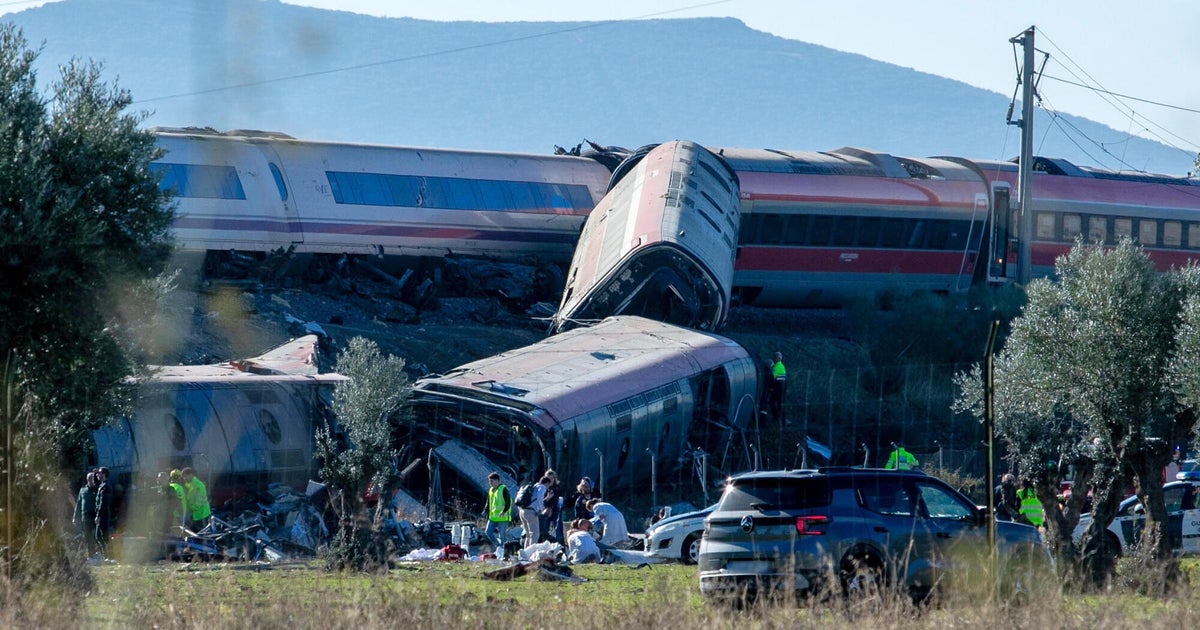
A high-speed train ran into the back of another that had stopped on the line in central Spain on Wednesday morning, according to local authorities. Two cars of the stopped train were knocked off the track. The regional government of Castilla-La Mancha confirmed at least 68 deaths and said another 58 people were being treated in hospitals. A local official said the toll is expected to rise.
Spain's rail operator ADIF said the crash happened in the province of Toledo. It took place on a flat stretch of track surrounded by olive fields between the towns of Urda and Los Yébenes. Carriages were torn into pieces of metal, and debris was scattered down a gravel slope. Rescue workers were still searching the wreckage for survivors and bodies, and rail service between Madrid, Ciudad Real and Andalusia was suspended.
An official identified as Padilla told state broadcaster TVE that both trains were traveling from Madrid to Seville. One was operated by state-owned RENFE and the other by private company IRYO. He said 397 passengers were aboard the RENFE train and 147 on the IRYO train.
What the transport minister says caused it
Transport Minister Óscar Puente said a computer malfunction disabled the security system on a 63-kilometer (39-mile) stretch at 8:30 a.m., which brought all trains there to a halt. He said the central command center then told the RENFE train to start moving again without speed restrictions. It collided with the stopped IRYO train at 8:53 a.m.
Puente called the command center's order "inexplicable." He said a "stop signal" was still active on the line, so the train should not have been told to proceed. At minimum, he said, it should have been told to travel at reduced speed. He said the train engineers were not to blame.
Authorities were still working to establish how fast the train was going. Puente said it could have been traveling at 200 kph (124 mph), the speed permitted on that section. "I am not attributing responsibility to anyone, I am just stating the facts," he said.
Survivors and rescue efforts
Health Minister Mónica García said emergency teams were concentrating on reaching survivors and bodies in the most heavily damaged cars. "It was a high-speed impact, so we are expecting this to be a tragedy," she said.
Ignacio Relaño, a passenger on the RENFE train, told TVE the train had stopped briefly and then started again before the crash. "We all felt the train abruptly slowing down and then the impact," he said. Another passenger told Cadena Ser radio that she was thrown forward in her seat and saw trapped people covered in blood.
Manuel Galán, mayor of nearby Urda, told TVE that civil protection authorities had asked the town hall to prepare a sports pavilion to receive passengers.
Political fallout and earlier crash
Prime Minister Pedro Sánchez spoke from the crash site and announced three days of national mourning. "Today all of Spain is grieving," he said. He called for greater safety measures to restore confidence in a high-speed rail network that was once a source of national pride. "It is unacceptable for a country like Spain to suffer two high-speed rail accidents in the same year," he said. Sánchez faces a national election on Nov. 29.
Trains from RENFE and IRYO were also involved in a deadly crash in January, when 45 people died in southern Spain after a train jumped the track and hit an oncoming train. That crash was the deadliest in Spain since a 2013 accident that killed 80 people, and it shook public confidence in the country's extensive high-speed network.