What changed in the policy
Google updated its privacy policy on October 16, according to Ars Technica, which credited Android Authority with spotting the revision. The change affects the section on ad personalization.
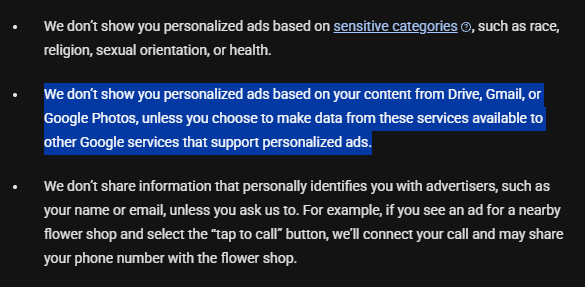
That section previously included a plain limit on certain apps. The old text said, "We don't show you personalized ads based on your content from Drive, Gmail, or Photos." Ars Technica reports that Google replaced this with new wording that leaves room for exceptions. The outlet argues that the revision opens the door to using data from apps like Gmail and Photos in ads when that data is shared with other Google services.
Google has long said it does not use sensitive data from products like Gmail, Drive and Photos for ad personalization. Ars Technica describes the update as appearing to dismantle that firewall.
The Personal Intelligence connection
According to Ars Technica, Google has a mechanism for sharing that data across services: Personal Intelligence, released in early 2026. The feature lets users hand data from multiple apps to Google's AI products, with the goal of giving the AI more context and producing better answers.
Personal Intelligence connects user data to the Gemini app and to features such as AI Mode search. Ars Technica notes that the Gemini app does not currently have ads, but people may see sponsored content in AI search tools. The outlet's reading is that the policy change acknowledges data shared with AI search through Personal Intelligence could contribute to ad personalization.
Ars Technica says that if someone uses AI Mode with Personal Intelligence enabled, summaries and insights drawn from their data may shape the answers they receive. Because the same data is used for ad targeting, the outlet writes, personal data can be an element of ad targeting in AI search.
What Google says
Google disputes the idea that ads will be built directly from private content. In a statement quoted by Ars Technica, the company said: "Connecting your apps is entirely opt-in. Ads will continue to be relevant to things like your query, the context of the response and your interests. Ads will not be based directly on your Gmail inbox or Photos library, and as always, sensitive information will not be used to tailor ads."
A Google spokesperson also told Ars Technica that the clarification does not signal a change in how the company handles data with respect to its advertising partners. According to that account, Google is not scanning a user's whole inbox to enhance an advertising profile and is not giving this data to third parties.
Ars Technica characterizes the statement as a roundabout confirmation that Workspace and Photos data may inform ads. The outlet says the practical result is that personal data piped into an AI search tool could influence the ads shown.
Wider concerns and how to opt out
Ars Technica places the change in the context of Google's push to make its products work together, which the company sees as a key strength of its AI efforts. Some apps, such as Gmail, still get protected status in Google's data handling, the outlet says, but there are now more routes for that data to leave those apps.
The outlet also points to a similar exception in how Google treats AI interactions for model training. Google says it doesn't use personal data for AI training but does use users' inputs and the model's outputs. Ars Technica notes that those outputs may contain personal information. Google has said it tries to filter such content out through user activity controls, but it does not promise it will always succeed.
Ars Technica acknowledges that Personal Intelligence is opt-in. It adds that Google uses prompts and pop-ups that may encourage people to turn it on without fully explaining the consequences, so some users may have enabled it unknowingly.
To keep personal data out of ad targeting in this way, the outlet advises turning Personal Intelligence off. That can be done in the Gemini settings for Personal Intelligence by disabling connected apps. It can also be done in the main Google account settings under Data & privacy, then Personalization settings, then Manage Personalized Recommendations in Search Services, then Connected Content Apps. From there, users can disable connections to Workspace and Google Photos.