What astronomers found
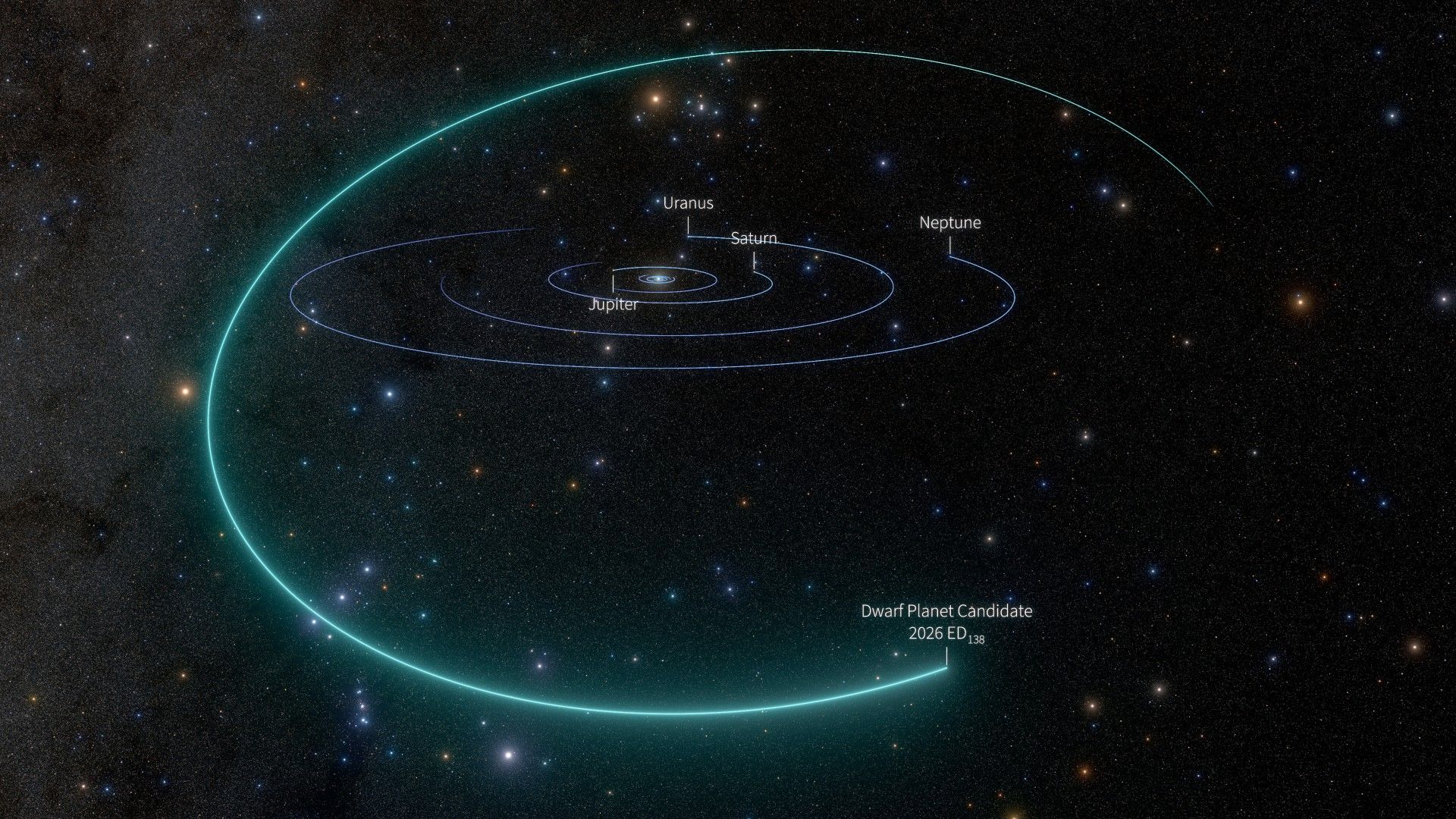
Astronomers using data from the Vera Rubin Observatory have identified a distant icy body that could be a dwarf planet, according to Space.com. The object, designated 2026 ED138, orbits the sun in the cold region beyond Neptune.
Scientists estimate it measures between 600 and 1500 kilometers (373 to 972 miles) across. A body of that size would probably be massive enough for its own gravity to pull it into a sphere. That trait is a key difference between dwarf planets and asteroids or other small space rocks.
The object currently sits about 46 astronomical units from the sun. One astronomical unit is the Earth-sun distance, roughly 93 million miles or 150 million kilometers. That places 2026 ED138 farther out than Pluto, whose average distance is about 40 astronomical units.
How the discovery happened
Matthew Holman of the Center for Astrophysics | Harvard & Smithsonian made the discovery. On Oct. 13, he was running archived Rubin data through a search code he built with CfA colleague Kevin Napier when the distant object appeared.
Despite its great distance, the body looked relatively bright. That suggested it is larger than a typical trans-Neptunian object, the category for icy bodies orbiting beyond Neptune.
Holman said in a statement released Tuesday, Oct. 27, the day the find was announced, "My first reaction was one of excited disbelief." He added, "Objects like this are very rare, so I immediately started checking whether I or the code had done something wrong."
Confirming the object is real
Holman and Mario Jurić, a University of Washington scientist who serves as Rubin Solar System Lead Scientist, checked the observatory's catalog and found that Rubin recorded 2026 ED138 on 30 separate occasions across 20 nights between March 4 and July 11 of this year.
Further searching showed that the Dark Energy Camera, mounted on the Víctor M. Blanco 4-meter Telescope at the Cerro Tololo Inter-American Observatory in Chile, had also captured the object. Its observations reach back to 2016.
The combined data show an orbit tilted about 25 degrees from the plane of the solar system. Scientists say that tilt likely came from a gravitational encounter with Neptune that pushed the object off its original path.
What happens next
The object's status remains unsettled. Astronomers will not know whether it counts as a dwarf planet until they pin down its size, which requires infrared observations. The James Webb Space Telescope is optimized for those wavelengths.
Rubin sits on Cerro Pachón in northern Chile and has a primary mirror 8.4 meters wide. It reached first light in April 2025 and began its main project, the 10-year Legacy Survey of Space and Time, in June of this year. Its 3.2-gigapixel camera, the largest digital camera built for astronomy, images the entire southern sky every few days.
Rubin has already found more than 11,000 new asteroids, and the survey is expected to add dwarf planets to the solar system inventory. "If confirmed as a dwarf planet, ED138 would join a very small family of worlds," Holman said. He also said, "Rubin will image the whole southern sky again and again for 10 years, so any others hiding in the places earlier surveys skipped are now within reach."